 Custom parts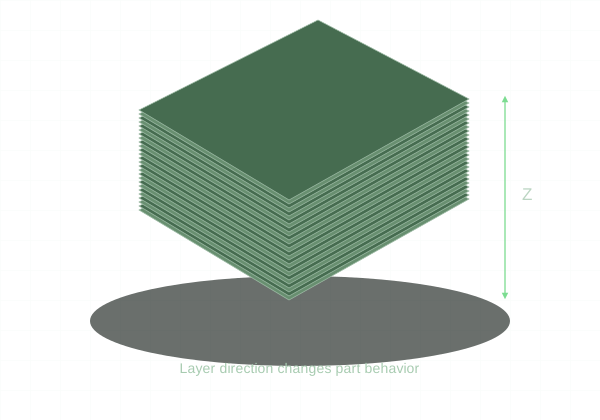
Treat PETG-CF as a particular printed composite, not a shortcut to a metal-like load rating.
Understand the material structure
The polymer binds short carbon fibers dispersed through the filament. Those fibers are different from continuous reinforcing fibers arranged in a laminate. Extrusion direction, layer bonding, and the geometry of the printed part remain important to performance.
Stiffness can help a fixture
A stiffer material may reduce movement in a suitable positioning aid or housing. That benefit does not automatically mean better impact resistance or stronger layer bonding. A thin snap tab may be a worse application than a broad supported block.
Surface appearance is not strength
The composite often has a matte appearance that makes layer lines less visually prominent. The physical layers still exist, and support-contact surfaces still differ. A visually smooth part can contain a weak load path if the geometry pulls apart across the build layers.
Make the prototype representative
Evaluate the actual material, orientation, wall layout, and loading direction. Infill percentage is only one variable. Avoid assuming electrical insulation, chemical compatibility, or a universal maximum temperature. KRC’s current PETG-CF offering is black and follows the standard print-review workflow.
Prusament: one PETG-CF formulation
Manufacturer data describes that formulation; it is not a specification for KRC’s supplied filament.