 Custom parts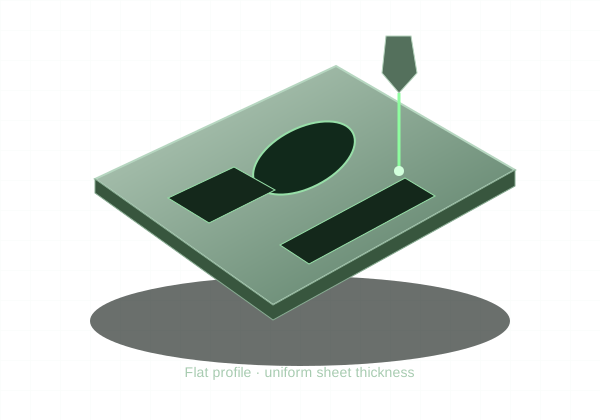
Choose plywood for a wood appearance and layered construction; make joint clearance a deliberate design choice.
Plywood behaves differently from MDF
Plywood uses bonded veneers with alternating grain directions. This gives it a different stiffness and appearance from fiberboard. Glue lines, internal voids, and natural variation can influence cutting behavior. A material family does not guarantee identical cosmetic grain from one sheet to the next.
Build assemblies around actual thickness
A nominal 1/4 inch sheet may not measure exactly 0.250 inch. Tab-and-slot assemblies need room for sheet variation, kerf, and the intended fit. A hand-assembled slip fit and a glued interference fit have different goals. A small joint coupon is useful before committing to a large interlocking assembly.
Keep fragile features supported
Long narrow fingers, tiny internal webs, and unsupported letter centers are vulnerable. Use bridges where an island must remain attached. Place sufficient material around mounting holes and avoid relying on a thin veneer edge for repeated screw loading.
Current KRC route
The laser selector includes Baltic birch plywood in nominal 1/8, 1/4, 3/8, and 1/2 inch thicknesses. Use clean full-size DXF geometry. Edge darkening and surface smoke effects are process considerations; finishing requirements should be part of the defined project scope.